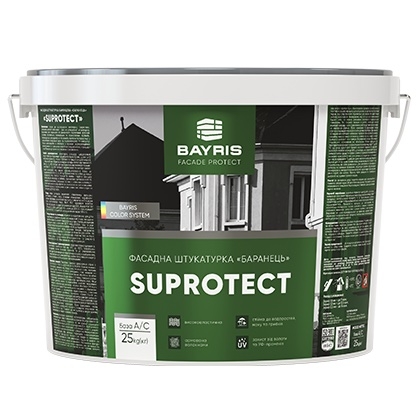
Available packaging and coverage
25 kg Grain size 1.5 mm – 2.2 kg/m², 1.0 mm – 2.0 kg/m², 0.5 mm – 1.8 kg/m²
Description and properties
Facade Render "SUPROTECT" – Pebble Texture by TM Bayris ("Suprotect" by TM Bayris) is a ready-to-use acrylic polymer render intended for both new-build and renovation finishing of residential, commercial, public and industrial building façades. It is recommended for finishing and protecting thermal insulation systems using expanded polystyrene (EPS). It can also be used in interiors exposed to high traffic and elevated humidity levels (stairwells, corridors, etc.). Suitable for both hand and machine application.
Technical characteristics
"Suprotect" Facade Render by TM Bayris creates a decorative pebble texture finish with grain sizes of 0.5 mm, 1.0 mm and 1.5 mm (particle size S3 – less than 1500 μm) and a dry film thickness E5 – greater than 400 μm. The finished surface has medium vapour permeability (class V2 – Sd ≤ 150 ˃ 15 g/(m²*day) for acrylic render), excellent water repellence (low water permeability class W3 ≤ 0.1 kg/(m²*h0.5)), and is elastic and resistant to algae, moss, mould and blue stain.
It reliably protects façades against weathering, industrial pollution and impact loads. Environmental benefits are confirmed in accordance with the requirements of the international standard DSTU ISO 14024.
Consumption:
– 1.5 mm grain size – 2.2 kg/m2
– 1.0 mm grain size – 2.0 kg/m2
– 0.5 mm grain size – 1.8 kg/m2
Tinting – can be tinted in various colours using water-based and universal pigment pastes by manual or machine tinting.
Base A – used as a white render and for tinting in light shades.
Base C – used exclusively for tinting in bright and saturated colours. The coating achieves its final colour after complete drying.
Tinted render cannot be returned or exchanged.
VOC content – VOC content complies with the requirements of the Technical Regulation on the Limitation of VOC Emissions, Order of the Ministry of Economic Development and Trade No. 1394 dated 02.10.2018 (subcategory "12", limit value up to 200 g/L, maximum actual content in ready-to-use form not exceeding 100 g/L).
Surface preparation
Surface preparation shall be carried out in accordance with DSTU-N B A.3.1-23:2013 and DSTU-N B V.2.6-212:2016. The substrate must be dry and free from dirt, dust, oil stains, mortar residues, soot, efflorescence and other contaminants. New cement and cement-lime substrates must be cured for at least 28 days before treatment, concrete surfaces for 3 months, and thermal insulation system surfaces for at least 72 hours under normal conditions.
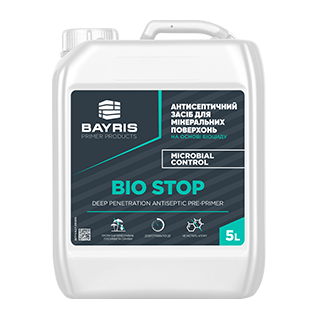
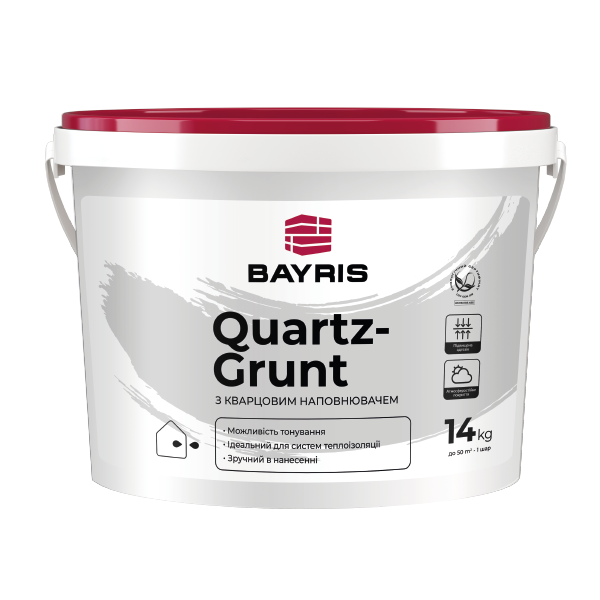
Areas affected by fungi, moss or algae should be mechanically cleaned and treated with “BioStop” by Bayris according to the instructions. After cleaning and dust removal, the surface should be treated with “Quartz-Grunt” acrylic bonding primer by TM Bayris (for acrylic render) to strengthen the substrate and equalise absorbency. The primer colour should be matched to the decorative render colour. After priming, allow the surface to dry for at least 4–6 hours before applying the render. Areas not intended for rendering should be protected with masking film.
Application
Before application, mix the render thoroughly with a low-speed mixer until homogeneous.
Depending on the substrate and application conditions (temperature, humidity, porosity and substrate type), the render may be diluted with water by up to 0.2 litres per bucket. To avoid colour and texture variations, the same amount of water should be added to every bucket.
Apply the render in a single coat onto a previously primed surface. Spread evenly using a stainless-steel trowel to a thickness corresponding to the maximum grain size. Texture formation can begin immediately after application but no later than 10 minutes afterwards under normal conditions. To achieve the pebble texture, use uniform circular movements with a plastic float, applying consistent pressure throughout the rendering process. Work continuously on each surface area, from corner to corner or between architectural joints. If a break in work is required, define the stopping point with masking tape. Remove the tape together with any remaining render immediately after texture formation.
For machine application – the appropriate technological parameters must be selected, including material consistency, nozzle diameter, feed rate and air pressure. Creation of the pebble texture with subsequent floating is optional.
Application should be carried out at substrate and ambient temperatures between +5°C and +30°C (avoiding direct sunlight) and at relative humidity not exceeding 80%. Do not apply during strong winds, rain or direct sunlight unless protective screening is used. These conditions should be maintained for at least 3 days after application (5 days for very intense colours). Failure to comply may reduce coating strength and lead to premature deterioration.
To ensure colour consistency on large surfaces, rendering should be carried out continuously using material from the same batch or by mixing different batches together.
Clean tools with water immediately after completion of rendering work.
Please note
Under normal conditions, the coating develops its full performance properties after 28 days. Intensive cleaning of rendered surfaces should therefore be avoided until this period has elapsed.
Manufacturer's warranty: the manufacturer guarantees that the render complies with the declared technical specifications. Any modification of the finished product composition, use for purposes other than intended and/or failure to follow the manufacturer's instructions may significantly affect its performance. The user is responsible for determining suitability and compatibility through trial application. The manufacturer shall not be liable for direct or indirect losses arising from product use, as it cannot control all application conditions.
Key product benefits at a glance
No time to read the full technical description?
We have prepared a brief summary of the most important product features:
SUPROTECT Acrylic Facade Render by TM Bayris is a decorative, weather-resistant pebble texture render that:
-
is ideal for finishing and long-term protection of residential, commercial and industrial façades;
-
is recommended for use in external insulation systems with expanded polystyrene (EPS);
-
offers good vapour permeability, water-repellent properties and resistance to fungi and weathering;
-
is available in 0.5 mm, 1.0 mm and 1.5 mm grain sizes (pebble texture finish);
-
is suitable for both manual and machine application.
SUPROTECT Acrylic Facade Render by TM Bayris is available at competitive prices with delivery throughout Ukraine from the online store BudBox, brand showrooms, and a wide network of retail partner stores across Ukraine (excluding temporarily occupied territories).
Video overview


-600x600.png "Professional Façade Cleaner \"Facade Bio Cleaner\" Concentrate 1:3")