Available packaging and coverage per litre
1 L 8–10 m²/L per coat
3 L 8–10 m²/L per coat
Description and properties
Semi-Matt Panel Varnish "AQUALACK" by TM "Bayris" ("Aqualack") is a water-dispersion varnish designed for the protection and decorative finishing of timber and wood-based surfaces (wall panelling, chipboard, fibreboard, QSB, OSB, MDF, etc.), new or previously painted mineral surfaces coated with water-dispersion paints, as well as wallpaper, brickwork, concrete, decorative renders and similar substrates for interior use. It is also suitable for refurbishment varnishing of surfaces previously coated with alkyd or nitrocellulose finishes.
The varnish is not intended for use on saunas, floors, furniture, window frames, doors, staircases, terraces or other surfaces exposed to intensive mechanical wear.
Characteristics
Semi-Matt "AQUALACK" by TM "Bayris" creates a decorative coating resistant to washing and protects surfaces against dirt and moisture. It improves wear resistance, preserves appearance and extends the service life of treated surfaces. The resulting finish is transparent and semi-matt (gloss level ˂ 20 at an angle of 60˚). Classification according to DSTU EN 13300:2022. Environmental benefits are confirmed in accordance with the requirements of the international standard DSTU ISO 14024.
Coverage: approximately 8–10 m²/L per coat depending on the substrate type, application method and painting tools used.
Under normal conditions, the varnished coating reaches its full performance properties 28 days after application. Intensive cleaning should therefore be avoided until this period has elapsed. The varnished surface may be cleaned with water or a warm soap solution using a soft sponge or cloth. Prolonged contact with water may cause temporary whitening of the coating, which disappears after drying and the transparency is fully restored.
Surface preparation
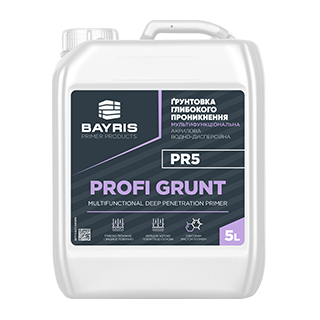
The substrate must be dry (wood moisture content not exceeding 15%, mineral substrates 4%, gypsum substrates 1%), and free from dirt, dust and other contaminants. New timber surfaces should be lightly moistened with water, allowed to dry and then sanded to remove raised wood fibres. To equalise absorbency and protect against biological degradation, algae, lichens, moss, fungi, mould, blue stain and wood-boring insects, it is recommended to treat the timber with “Base Grunt” TM Bayris according to the instructions. Loose old coatings (paint, varnish, etc.) should be removed mechanically and the surface dusted off. Highly absorbent mineral substrates should be pre-treated with “Profi Grunt” TM Bayris according to the instructions. Hard, glossy surfaces should be sanded to a matt finish and cleaned of dust. If the type of previous coating is unknown, a compatibility test application is recommended. Areas not intended for varnishing should be protected with masking film.
Application
Apply the varnish to the prepared surface in 2–3 coats (depending on the timber species and substrate porosity). The minimum interval between coats is 2–4 hours depending on weather conditions. When working with timber surfaces, apply the varnish along the grain from edge to edge. After the first coat has dried, lightly sand the surface with fine abrasive paper and carefully remove all dust. Depending on the substrate and application conditions (temperature, humidity, porosity and substrate type), the varnish may be diluted with up to 10% water for the first coat. Dilution is not recommended for the final coat. Please note that adding water always reduces the performance properties of the coating. Before application, stir thoroughly with a low-speed mixer until homogeneous. Apply by brush, roller or spray equipment. Application should be carried out at substrate and ambient temperatures between +5°C and +30°C (avoiding direct sunlight) and relative humidity not exceeding 80%. Temperatures above or below the recommended range, or draughts during application, may result in poor film formation. Clean tools with water immediately after use.
Attention! Any modification of the finished product composition, use of the product for purposes other than intended and/or failure to follow the manufacturer's instructions may significantly affect its quality characteristics. The suitability of the product for specific materials and/or compatibility with other materials must be determined by the user through trial application. The manufacturer shall not be liable for any direct or indirect losses resulting from the use of the product, as all application conditions cannot be controlled.
Safety precautions and disposal
May cause an allergic skin reaction. Keep out of reach of children. Avoid breathing vapours. Wear protective gloves. IF ON SKIN: Wash with plenty of soap and water. If skin irritation occurs: seek medical advice/attention.
Dispose of contents and container in accordance with national regulations (in compliance with DSTU 4462.3.01:2006).
VOC content
VOC content complies with the requirements of the Technical Regulation on the limitation of VOC emissions, Order of the Ministry of Economic Development and Trade No. 1394 dated 02.10.2018 (subcategory "5", limit value up to 130 g/L, maximum actual content in ready-to-use form not exceeding 30 g/L).
Varnish for the protection and decorative finishing of timber and wood-based surfaces (wall panelling, chipboard, fibreboard, QSB, OSB, MDF, etc.), new or previously painted mineral surfaces coated with water-dispersion paints, as well as wallpaper, brickwork, concrete, decorative renders and similar substrates.
Packaging 1 L; 3 L
Gloss level semi-matt
Base water-based
Coverage 8–10 m²/L per coat
Number of coats 2–3 coats recommended
Drying time 2–4 hours for each coat