
Timber Fire and Biological Protection: How It Works?
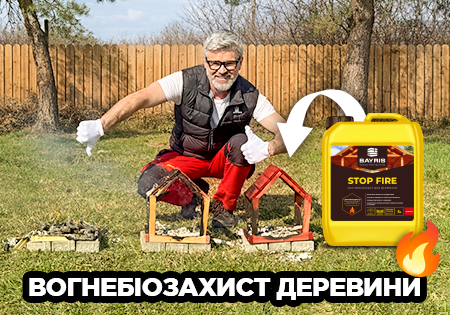
Timber is widely used in construction — from roof truss systems to timber-frame houses. However, alongside its advantages, it also has weaknesses: flammability and susceptibility to biological deterioration.
This is precisely why fire-retardant and preservative protection for timber is used — a treatment that combines the functions of a fire retardant and a wood preservative.
What Is Fire-Retardant Timber Protection and How Does It Work?
Fire-retardant timber treatments are specialised formulations that:
- penetrate deep into the timber structure
- reduce its tendency to ignite
- slow down the spread of flames
- protect against fungi, mould and wood-boring insects
Unlike decorative timber products (wood preservatives, stains and glazes) or varnishes and wood lacquers, most of these protective treatments do not form a surface film. Instead, they work within the material itself by penetrating the timber structure.
⚠️ Important: This Does Not Make Timber Non-Combustible!
In practice, many people expect treated timber to become “fireproof”.
As an expert team, BAYRIS always explains honestly:
Fire-retardant treatment does not make timber non-combustible.
Its actual purpose is to:
- make ignition more difficult
- slow the development of a fire
- reduce the intensity of burning
- provide additional time before structural failure occurs
This is critically important in real-life situations, as it provides valuable time for:
- evacuation
- emergency service response
In other words, it is a safety measure, not a guarantee.
Fire Protection Classes: What Determines Them?
You will often see references to:
- Class I fire protection
- Class II fire protection
However, there is one key point:
The fire protection class depends not only on the product itself but also on the application method and the treatment rate.
Main Application Methods:
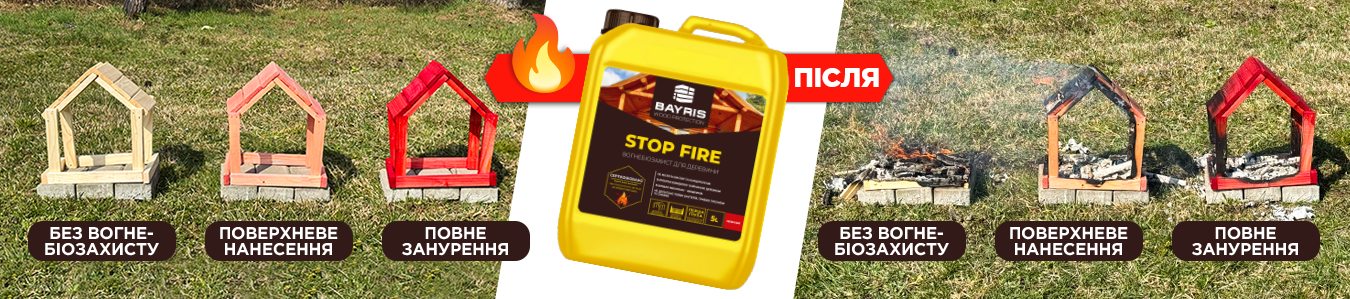
1. Surface Application (Brush, Roller or Spray)
- the most common method
- widely used on construction sites
- typically achieves Class II fire protection
- application rate: approx. 500–600 ml/m²
✔ Suitable for:
- roof trusses
- beams
- exposed timber structures
2. Immersion Treatment (Dip Tanks)
- deeper penetration
- more uniform saturation
✔ Can achieve a higher level of protection, approaching Class I performance (see the Information Note below for details).
3. Hot-and-Cold Bath Method
- professional treatment technology
- maximum depth of impregnation
✔ Makes it possible to achieve Class I fire protection
4. Pressure Treatment (Autoclave)
- industrial-grade process
- controlled pressure impregnation
✔ Delivers the best penetration performance
Conclusion: the same product can deliver different results depending on how it is applied.
Information Note. Can Class I Fire Protection Be Achieved Using the Immersion Method?
In practice, immersion treatment is often regarded as a “guarantee” of a high level of protection. However, it is important to understand that the immersion method alone does NOT guarantee Class I fire protection performance. As a professional team, BAYRIS explains this openly: the result is always a combination of several critical factors.
What Conditions Must Be Met Simultaneously?
To achieve a result as close as possible to Class I fire protection, all of the following conditions must be met:
1. High-Quality Formulation
- certified fire-retardant treatment
- a proven formula containing an adequate level of fire-retardant components
2. Correct Concentration as Specified by the Manufacturer
- if the product is supplied ready for use, water must not be added under any circumstances
- if dilution is permitted, the specified mixing ratio must be followed precisely (“by eye” or “a little extra water” can significantly reduce performance)
3. Sufficient Uptake (Retention Rate)
- a key performance parameter
- for Class I protection: approximately 200–300 l/m³
Without achieving this level of uptake, Class I performance is physically impossible.
4. Immersion Time
- short immersion = surface-level effect only
- extended immersion (sometimes several hours) = deep penetration
5. Timber Moisture Content and Condition
- moisture content up to approximately 25%
- free from dirt, dust and previous coatings
- open pore structure
6. Timber Species
- softwoods generally absorb treatment more effectively
- hardwoods are typically more difficult to impregnate
7. Processing Conditions
- temperature and ambient humidity
- timber must not be frozen
- consistent process control
Important Conclusion and Recommendation
Only when ALL of these factors are met simultaneously can immersion treatment achieve performance close to Class I fire protection. If guaranteed Class I protection is required, either the hot-and-cold bath method or pressure impregnation (autoclave treatment) should be used.
Colourless or Pigmented Fire-Retardant Treatment: Which Should You Choose?
Fire-retardant timber treatments are available in two versions:
Colourless Fire-Retardant Treatment:
- does not alter the natural appearance of timber
- suitable for subsequent decorative finishing
- application coverage is harder to monitor visually
Fire-Retardant Treatment with Indicator Pigment:
- has a light tint (commonly red)
- makes it easy to see where the product has been applied
- the pigment does not affect protective performance
- the colour may gradually fade over time
A practical approach:
- for critical structural elements, a pigmented version is often preferred
- for decorative applications, a colourless version is usually chosen
Protection Against Biological Deterioration
In addition to fire protection, a high-quality timber treatment:
- helps prevent fungal growth
- protects against timber decay
- inhibits mould development
- helps prevent insect infestation
This is particularly important for:
- loft spaces
- enclosed timber structures
- areas exposed to elevated moisture levels
How to Treat Timber Correctly
Before Application:
- remove dust and dirt
- remove old coatings
- allow the timber to dry (moisture content up to 25%)
Application Process:
- apply in multiple coats
- allow suitable intervals between coats (approximately 6 hours)
- do not apply at low temperatures
Common Mistakes That Significantly Reduce Performance
- applying to damp timber
- insufficient application rates
- attempting to dilute the product improperly
- using unverified or unknown formulations
How to Choose a High-Quality Fire-Retardant Timber Treatment
Look for:
- relevant certification
- a verified fire protection classification
- clear and transparent technical information
- realistic and documented coverage recommendations
Conclusion
Fire-retardant timber protection is:
- not a “magic liquid”, but an engineered safety solution
- an effective tool for reducing risk
- a critically important stage in ensuring structural safety
Most importantly, the result depends not only on the product itself, but also on how it is applied in practice.
Where Can You Buy High-Quality Fire-Retardant Timber Protection?
If achieving reliable performance and compliance with the declared specifications is important to you, it is worth choosing products from trusted manufacturers.
Fire-retardant timber protection products from BAYRIS, including the Stop Fire range, are available:
- through independent builders’ merchants
- via national DIY retail chains
- at BudBox branded showrooms
- online with delivery throughout Ukraine
For professional users and large-scale projects, wholesale supply options are also available (including industrial packaging in 200-litre and 1,000-litre containers), with VAT invoicing through official BAYRIS representatives. This helps ensure product authenticity and provides access to professional guidance on correct application methods.